

Bare Finish Steel Raised Floor
Source durable raised access flooring from expert raised access flooring manufacturers. Industrial steel panels with high load capacity for any raised floor system.
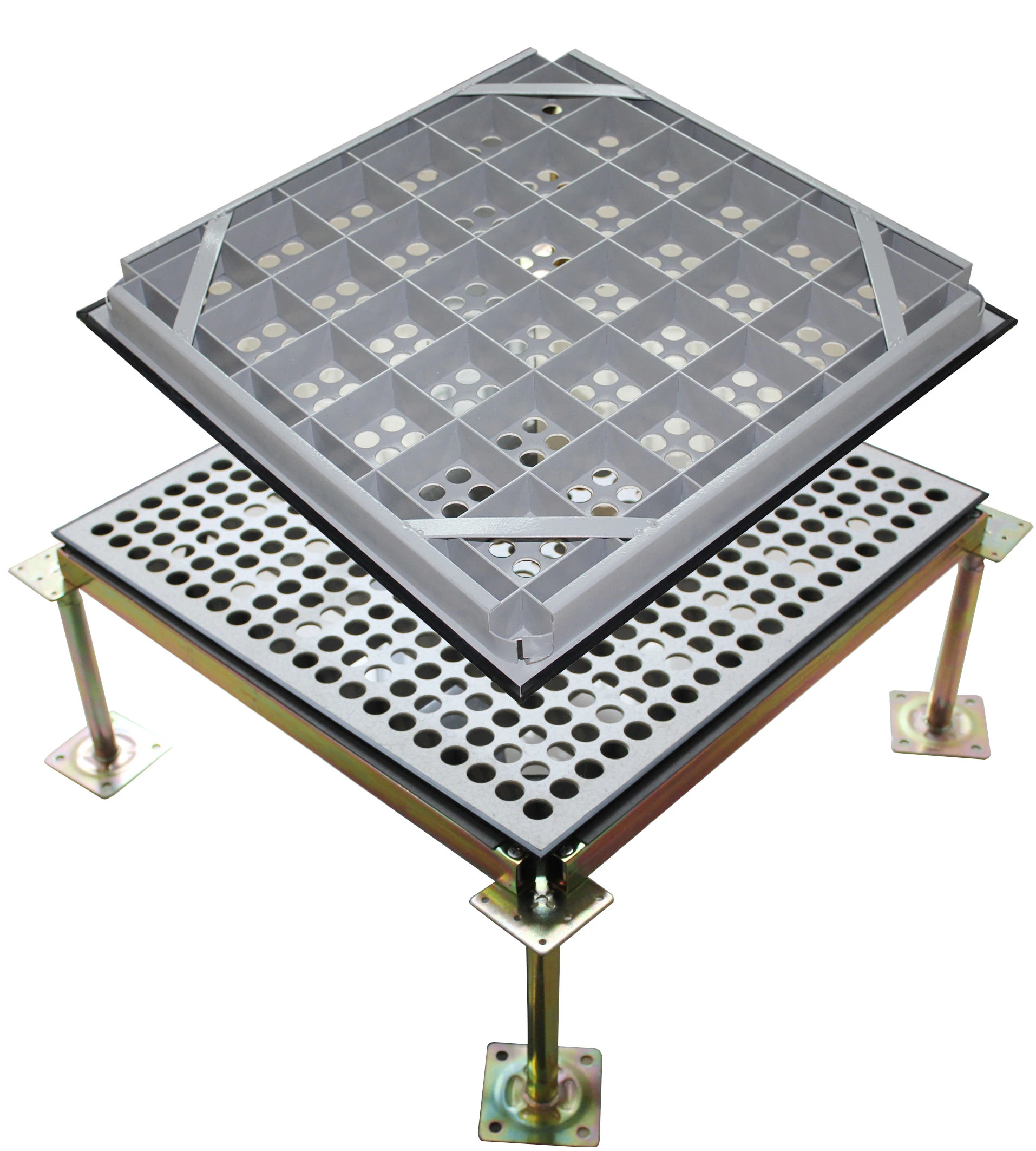
View productChoosing between the raised access flooring manufacturers bidding on your project is harder than specifying the panel itself. This guide hands procurement teams a factory-signal checklist, a twelve-point RFQ, the published FS662–FS2000 load table and the cost drivers behind every figure, so that any access flooring company can be compared on identical terms — starting with the 45% Ventilation Steel Air-flow Raised Floor.
Price is the last thing that separates suppliers. These six signals separate a plant that builds panels and pedestals from a middle layer that forwards your drawing and marks up the reply. Read the right-hand column before you release a deposit.
| Signal to test | What a real manufacturer shows | What a trader or reseller shows |
|---|---|---|
| Answers on technical questions | Factory signalEngineering replies on load class, steel gauge, dimensional tolerance and pedestal height — in writing. | CautionSales-only replies, brochure links, or “we will check” on anything measurable. |
| Scope of the quoted system | Factory signalPanels, pedestals and stringers quoted together as one matched floor system. | CautionPanels only, with pedestals sourced elsewhere or left to your installer. |
| Load data published | Factory signalA model table (FS662–FS2000) that names the test type: concentrated, impact, ultimate, uniform and rolling. | CautionOne headline “load rating” with no model reference and no test type. |
| Response to your drawing | Factory signalVentilation rate, finish and pedestal height discussed against your layout, even where variants exist. | CautionFixed catalogue variants only; your drawing is never actually read. |
| How the price is presented | Factory signalLine-item build-up covering gauge, infill, finish, pedestal and packing. | CautionA single lump-sum figure with no build-up and no exclusions listed. |
| Verification before deposit | Factory signalSample, pre-shipment approval and third-party inspection options discussed up front. | CautionPayment-first, with inspection arrangements deferred to after the transfer. |
Send these twelve points to every supplier on your shortlist, in the same order. Each answer changes the number that comes back, so a supplier who skips a line has not quoted the same product as the others.
Two suppliers can quote the “same” 600 × 600 steel panel and land thousands of dollars apart. Here are the six layers that move the figure — no prices, just the levers, so every quote becomes comparable.
Thinner sheet trims weight and cost, and lowers the impact and rolling values the finished panel can certify.
Bare finish, cement infill and calcium sulphate cores sit in different cost bands and behave differently under point loads.
An antistatic coating adds a process step, and the finish you choose also decides the cleaning routine on site.
Taller or more finely adjustable pedestals consume more steel and hold tighter tolerances.
A non-standard panel size or ventilation pattern needs its own tooling, amortised across your order quantity.
Panel thickness, pedestal cartons and pallet stacking determine how many containers you actually pay for.
The published model table below is the only load claim worth comparing across suppliers. It names six models and five different test types — a quote that answers with one number is not answering the question.
Pick the model from the loads your floor will actually carry, then ask every supplier to quote that model by name. A heavier class than you need shows up immediately in steel gauge, weight and freight — a lighter class than you need shows up later, under a cabinet.
Before the deposit, agree the sample and pre-shipment approval route, and confirm whether a third-party inspection will attend. On a quote sheet, verification terms belong on the same page as the price.
| Model | Concentrated load (N) | Impact load (N) | Ultimate load (N) | Uniform load (N/m²) | Rolling load (N) – 10 times | Rolling load (N) – 10,000 times |
|---|---|---|---|---|---|---|
| FS662 | ≥3000 | ≥445 | ≥9000 | ≥12500 | 2946 | 2356 |
| FS800 | ≥3600 | ≥536 | ≥10800 | ≥16100 | 3560 | 2670 |
| FS1000 | ≥4500 | ≥670 | ≥13500 | ≥23000 | 4450 | 3560 |
| FS1250 | ≥5600 | ≥780 | ≥16800 | ≥33000 | 5560 | 4450 |
| FS1500 | ≥6700 | ≥1005 | ≥20100 | ≥34500 | 6675 | 5340 |
| FS2000 | ≥8900 | ≥1340 | ≥26700 | ≥46000 | 8900 | 7120 |
Four common briefs, each tied to a published product fact and the decision that follows from it. Use them to write the RFQ line that matters most in your project.
Product factThis panel delivers a 45% open ventilation area, and the line covers ventilation rates from 15% to 65%.
Buyer decisionSize the ventilation rate against your rack heat density, then confirm the rolling load for server trolleys and castors before the model is frozen.
Product factAntistatic surface treatment with adjustable pedestals, built for rooms that also carry air conditioning.
Buyer decisionSpend the budget on antistatic finish and cable management rather than on the heaviest load class the supplier offers.
Product factFS1250 to FS2000 carry ≥5,600 to ≥8,900 N concentrated and up to ≥46,000 N/m² uniform load.
Buyer decisionName the heaviest wheeled load and how often it crosses the floor — rolling load at 10,000 passes is where shortcuts surface.
Product factFire-resistant steel construction, recyclable panels and a modular layout that fits standard raised floor systems.
Buyer decisionPrioritise finish, edge sealing and gasket detailing; reserve the load-class discussion for the areas where trolleys actually pass.
Attach your layout, name the load class and the ventilation rate you need, and state your destination port and Incoterm. You will get a line-item quote that can be placed beside any other supplier's answer — panel, pedestal, stringer, packing and freight all visible on one page.
Keep adjacent product options together for a faster catalog comparison.
Source durable raised access flooring from expert raised access flooring manufacturers. Industrial steel panels with high load capacity for any raised floor system.
View product
Professional-grade raised access floor system. Durable steel panels with cement infill engineered by raised access flooring manufacturers for data centers.
View product
Ensure long-lasting durability with our raised access floor solutions. Designed for server room flooring with adjustable pedestals for heavy-duty access flooring.
View productfs662 through fs2000 are the six models published on the product page. each model carries its own concentrated load, impact load, ultimate load, uniform load and rolling load values — from ≥3000 n concentrated and ≥12500 n/m² uniform at fs662 up to ≥8900 n concentrated and ≥46000 n/m² uniform at fs2000.
ask every supplier for the same twelve rfq points: panel type, load class, finish or antistatic requirement, pedestal and stringer specification, stringerless or stringer layout, dimensional tolerance, packing method, test reports, hs code, moq, lead time and incoterms. a quote that answers all twelve compares line by line; a lump-sum figure does not.
the 45% ventilation steel air-flow raised floor has a 45% open ventilation area, and the product line covers ventilation rates from 15% to 65%. choose the rate that matches your cooling design and cabinet heat density, and confirm it in writing before the order is placed.
concentrated load is a point force applied at the worst position on the panel and is published in newtons. uniform load is spread across the whole panel face and is published in newtons per square metre. impact load checks a dropped object, and rolling load repeats a moving wheel 10 times and 10,000 times. a single load rating without the test type cannot be compared.
the published line already covers a 15% to 65% ventilation range, antistatic surface treatment and adjustable pedestal heights, and the wider floor system includes bare finish, cement infill and calcium sulphate panels. send your drawing and load requirement through the contact us page so the specific finish, ventilation rate and pedestal height can be confirmed.
moq, lead time and incoterms are not fixed on the product page; they follow the model mix, the finish and the destination. include quantity, destination port and your preferred incoterm in the request, and the terms will be confirmed with the quotation. reach the team at maria@riseflorsolution.com or +86-19880384598.